Creating a treasure hunt for kids is always exciting—but writing good treasure hunt clues is usually the hardest part. Clues need to be clear enough for children to solve, fun enough to keep them engaged, and perfectly adapted to their age and environment.
In this guide, you’ll learn exactly how to create treasure hunt clues your kids will love. We’ll walk through simple steps to write age-appropriate hints, explore the most popular types of clues (from riddles and picture puzzles to secret codes), and help you choose the right level of difficulty for different age groups.
Since 2013, I’ve been creating treasure hunts, mystery games, and escape-style adventures for children, and I’ve learned what really works to keep kids motivated and successful. Let’s start by breaking down what treasure hunt clues are and how to design them easily.
What Are Treasure Hunt Clues for Kids?
Treasure hunt clues are short hints, puzzles, or simple challenges that guide kids from one hiding place to the next. Each clue reveals a small piece of information that helps them move forward until they finally reach the treasure.
A good clue should be:
- clear enough for kids to solve,
- fun enough to keep them motivated,
- age-appropriate,
- adapted to your space (indoors, outdoors, backyard, classroom).
Treasure hunts and scavenger hunts are extremely popular in the United States because they mix problem-solving, movement, and excitement. With the right clues, kids stay focused, confident, and engaged from start to finish.
Now that you know what a clue is, let’s look at how to create them step by step.
How to Create Treasure Hunt Clues for Kids
Designing good treasure hunt clues becomes much easier when you follow a simple structure. Start with the basics, choose your hiding places, and match each location with a clear hint adapted to your child’s age. Here’s how to do it step by step.
Start with the treasure hunt basics
Before writing any clues, clarify the essentials of your game. This helps you choose the right difficulty and the right clue format.
Think about three key points:
- Type of game: treasure hunt, scavenger hunt, mystery game, or escape-style adventure.
- Age group: preschoolers, early elementary, or older kids.
- Location: indoors, outdoors, backyard, park, or classroom.
Once these basics are set, creating clues becomes much more straightforward.
Choose your hiding places first
Always list your hiding spots before writing the clues.
Most treasure hunts work well with 5 to 10 locations.
Examples of easy hiding places:
- under a pillow
- behind a book
- inside a shoe
- near the mailbox
- under a kitchen chair
When you know exactly where the kids must go next, writing the right clue is much easier.
Match each hiding place with one simple clue
A simple rule keeps everything clear:
? One hiding place = one clue.
Each clue should:
- point naturally toward the next location,
- stay age-appropriate,
- be fun and easy to understand,
- avoid confusion or multiple interpretations.
Kids stay much more engaged when every clue feels like a small victory.
Keep clues age-appropriate
Younger kids need visual or very simple clues.
Older kids can handle riddles, codes, or multi-step hints.
As a general guide:
- Ages 4–5: pictures, colors, arrows, very simple puzzles.
- Ages 6–7: short riddles, rebus, simple codes.
- Ages 8–12: longer riddles, secret messages, multi-step clues.
Choosing the right difficulty ensures kids stay confident and motivated.
You can also explore our collection of printable treasure hunts for kids to find ready-to-use adventures.
Now that you know how to build clear and effective clues, let’s explore the most popular types of treasure hunt clues kids love.
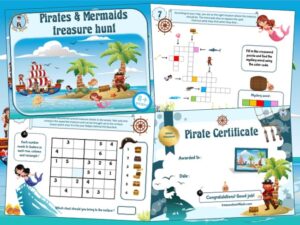
Types of Treasure Hunt Clues Kids Love
Kids stay engaged when treasure hunt clues are varied, visual, and fun to solve. Mixing several types of clues also helps keep the adventure exciting from start to finish. Here are the most popular clue formats you can use with children of different ages.
Picture clues and simple puzzles
Picture-based clues work well for younger children because they rely on visual understanding instead of reading skills.
You can use:
- Simple puzzles: cut a photo of the next hiding place into a few pieces.
- Spot-the-difference pictures: two images where kids must find 5–7 changes.
- Missing object puzzles: show a picture, then the same picture with one element missing.
These clues guide kids naturally toward the next location.
Rebus and picture codes
A rebus mixes small drawings and letters to create a word or short phrase. Kids identify each element and combine the sounds to guess the clue.
Rebus examples work well for revealing:
- a location (“under the table”),
- an object (“shoe”),
- or a theme-related word (“pirate,” “mermaid,” “garden”).
This type of clue is ideal for ages 5–7.
Riddle and rhyming clues
Short riddles are a classic treasure hunt tool. They help kids think, decode simple hints, and feel proud when they find the answer.
A good riddle should be:
- short,
- clear,
- written with simple vocabulary,
- focused on one idea.
Rhyming clues also work very well because the rhythm helps kids guess the meaning.
Secret codes and coded messages
Secret codes add a fun “mystery” layer to the hunt, especially for older kids.
Popular coded clues include:
- Color codes: each color = one letter (perfect for ages 4–6).
- Number substitution: numbers represent letters.
- Phone keypad codes: kids decode using a phone-style number pad.
- Symbol tables: simple icons matched to letters.
Kids love the challenge of cracking a message before moving to the next spot.
Mazes and paths to follow
A maze is a quick and playful way to reveal a letter, symbol, or word.
Kids solve the maze, follow the path, and discover the next hint.
It’s a great option for indoor treasure hunts and for children who enjoy logic games.
Dot-to-dot drawings
Dot-to-dot games reveal a picture when kids connect the numbers in order.
The final drawing can point to:
- an object,
- an animal,
- a location in the house or backyard.
You can control the difficulty based on the number of dots.
Action challenges and mini-games
Action clues add movement to your treasure hunt and help break up logic-based puzzles.
Examples include:
- egg-and-spoon race,
- relay challenge,
- throw a ball into a bucket,
- balance challenge,
- quick obstacle path.
Once the challenge is completed, hand the next clue to the team.
Now that you know the best clue types to mix into your treasure hunt, let’s see how to adapt them to different age groups so every child can succeed.

Adapting Treasure Hunt Clues by Age
Clues must match the child’s age so the treasure hunt stays fun, fair, and motivating. When the difficulty is right, kids stay engaged and feel confident solving each step. Here’s how to adjust your clues for different age groups.
Treasure hunt clues for preschoolers (ages 4–5)
Young children need clear, visual clues that don’t require reading.
Best clue types:
- picture puzzles,
- simple arrows or color codes,
- dot-to-dot drawings with 10–15 dots,
- very short picture-based rebus clues,
- obvious hiding places (pillow, toy box, chair).
Keep instructions simple and give kids immediate feedback to keep the pace.
Clues for early elementary kids (ages 6–7)
Kids at this age can read short sentences and enjoy slightly more complex clues.
Best clue types:
- short riddles,
- simple rebus with sounds,
- basic secret codes (symbols, colors, numbers),
- “missing object” puzzles,
- small mazes.
This age group loves clues that feel like a challenge but remain solvable within a minute or two.
Treasure hunt clues for older kids (ages 8–12)
Older kids enjoy multi-step clues that require more thinking.
Best clue types:
- detailed riddles,
- substitution codes,
- phone keypad codes,
- longer mazes,
- multi-part hints (find, decode, then locate).
This age range is also perfect for themed mysteries or escape-style hunts.
With age-appropriate clues in place, your treasure hunt will feel balanced and enjoyable for every child. Let’s finish with a few practical tips to make your game run smoothly.
Practical Tips to Keep Your Treasure Hunt Fun
A great treasure hunt is not only about the clues — it’s also about pacing, clarity, and keeping kids engaged. Here are a few simple tips to make your treasure hunt run smoothly from start to finish.
Test your clues beforehand
Walk through the treasure hunt yourself to make sure every clue makes sense, is easy to find, and leads to the correct location. A quick test helps avoid confusion on the big day.
Balance easy and challenging clues
Mix simple clues with slightly harder ones so kids never feel stuck. Alternating difficulty keeps the game fun and motivating for all ages.
Keep hiding places safe and accessible
Avoid fragile objects or locations that require climbing or unsafe movement. Choose spots kids can reach easily, indoors or outdoors.
Have a backup hint ready
If a clue is too difficult, offer a small hint so kids can move forward without frustration. It keeps the energy positive and the game flowing.
Manage the game duration
For most treasure hunts, 30 to 60 minutes is ideal. Adapt the length depending on the number of clues and your group’s age.
For a step-by-step guide to planning your treasure hunt, take a look at our article on how to make a treasure hunt.
Now that you’re ready to design clear, fun, and balanced clues, let’s answer the most common questions parents ask when planning a treasure hunt.
FAQ: Treasure Hunt Clues for Kids
Treasure hunt clues often raise similar questions, so here are quick answers to help you plan your game with confidence.
Most kids’ treasure hunts work well with 5 to 10 clues. This keeps the game exciting without overwhelming younger players. Choose the number of clues based on age, space, and how long you want the treasure hunt to last.
The easiest clues for young kids include picture clues, simple arrows, color codes, and very short riddles. These formats help preschoolers and early readers understand the next location quickly.
To write rhyming clues, create two short lines that describe the next location using simple vocabulary. End each line with words that rhyme so kids can guess the hiding place quickly and confidently.
Use secret codes, multi-step riddles, phone keypad clues, or substitution ciphers. Older kids enjoy clues that require decoding or solving a small puzzle before finding the next hiding place.
Yes, you can reuse many clues—puzzles, riddles, and code-based hints work with any theme. Simply adjust the final answer or hiding place to fit the new storyline or location of your treasure hunt.
These quick answers cover the basics, but a few final tips will help you create a smooth and successful treasure hunt from start to finish.
Conclusion and Next Steps
Creating great treasure hunt clues is simply a matter of choosing the right hiding places, matching each spot with a clear hint, and adapting the difficulty to your group. With a mix of puzzles, riddles, picture clues, and simple codes, your treasure hunt will stay fun, balanced, and exciting for every child.
I’ve been designing treasure hunts, mystery games, and escape-style adventures for kids since 2013, and the same rule always applies: kids love clues that make them think just enough to feel proud when they find the answer.
If you want to save time, explore our ready-to-print treasure hunts, mystery games, and escape-room kits for kids—perfect for birthdays, classrooms, and family activities.
You can also browse our collection of free printable games to get even more ideas for your next adventure.