Looking for science birthday party ideas that are exciting for kids but still manageable at home? A few hands-on experiments, creative lab decorations, themed snacks, and one main group activity are all you need to turn a birthday celebration into a memorable science adventure.
The key is not to pack the schedule with experiment after experiment. Choose a few hands-on science and STEM activities that let kids mix, test, observe, and explore, then build the party around a larger game or challenge that brings everyone together.
Set Up Your Science Party Lab
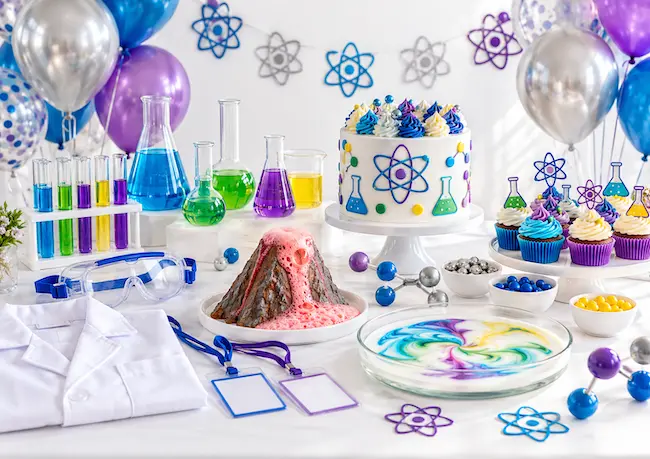
You don’t need elaborate decorations to create a convincing science lab. A few recognizable details can transform a kitchen, dining room, or party space and immediately set the mood.
Start with a simple color palette such as white, blue, green, purple, and silver. Then add a few laboratory-inspired touches:
- clear containers filled with colored water;
- test tubes, beakers, or plastic lab equipment;
- atom and molecule decorations;
- a periodic table poster;
- balloons decorated with science symbols;
- “Science Lab” or “Authorized Scientists Only” signs;
- safety goggles and oversized white button-down shirts as lab coats;
- scientist name badges for each guest.
Once the main decorations are in place, there is no need to fill every corner. A decorated experiment table and a few well-chosen props will make the theme immediately recognizable.
Invitations can become part of the experience too. Design them as lab access passes, science fair invitations, or confidential notices inviting young scientists to report for an important experiment.
Science Birthday Party Ideas: Easy Experiments
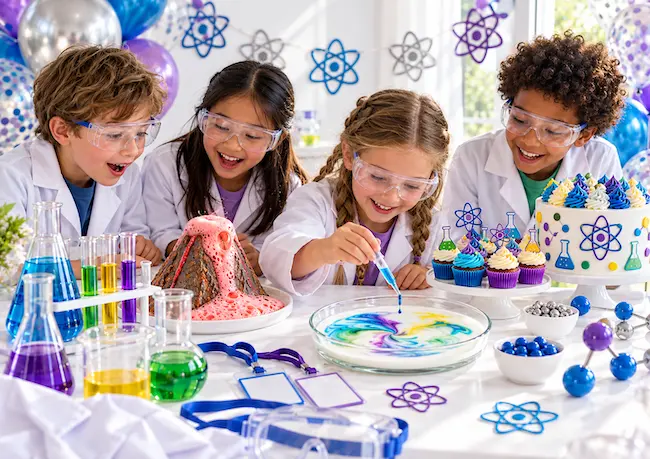
Hands-on experiments are usually one of the most anticipated parts of a science-themed birthday party. Two or three are plenty, especially if you also have a longer game planned.
Choose experiments with quick, visible results and prepare all supplies before the guests arrive. Testing each experiment ahead of time will also help you avoid surprises on party day.
Make Magic Milk
Pour milk into a shallow dish and add several drops of food coloring without stirring them together. Dip a cotton swab into dish soap and touch it to the surface of the milk.
The colors quickly swirl and move across the dish. It’s simple, colorful, and gives kids an opportunity to observe what happens when dish soap interacts with the fat and surface of the milk.
Mix Up Some Oobleck
Combine cornstarch with water until the mixture behaves like both a liquid and a solid. Press it quickly and it feels firm. Let it rest in your hand and it begins to flow.
Divide the oobleck between several containers so everyone gets a chance to experiment with it. Covering the table first is highly recommended—exploring oobleck can get messy.
Launch a Balloon Rocket
Thread a long piece of string through a straw and secure the string tightly between two points. Inflate a balloon without tying it, tape it to the straw, and let go.
Kids can experiment with balloon sizes or race two rockets side by side. It adds movement to the party and introduces a simple way to explore force and motion.
Try a Fizzing Reaction
Baking soda and vinegar remain a party favorite for a reason: the reaction is immediate and easy to see.
Instead of building one large volcano, prepare several small containers so kids can create individual fizzing reactions. Food coloring can make each one different.
These experiments work well at the beginning of the party while everyone settles in. Once your young scientists have warmed up, you can move from experimenting to solving a much bigger scientific mystery.
Turn the Party Into a Science Mystery
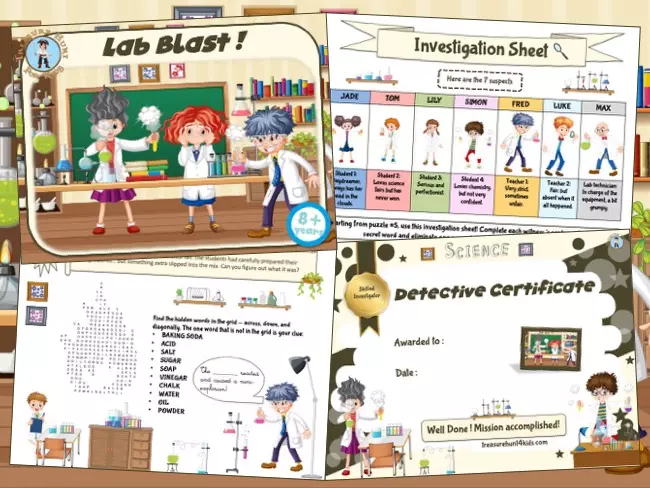
Experiments are fun on their own, but a main group activity gives the party a story and a shared goal. Lab Blast turns the science theme into a complete mystery the kids have to solve together.
A school science fair is about to begin. The experiments are ready, the equipment is in place, and everyone is waiting for the demonstrations to start.
Then an explosion rocks the lab.
Equipment has been damaged and the science fair is stopped. Was it simply an accident, a mistake during an experiment, or deliberate sabotage?
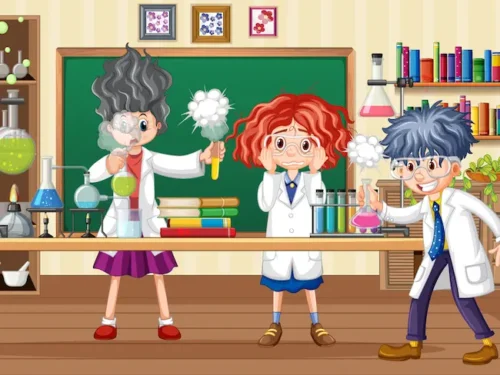
The kids become investigators. Using their investigation sheet, they examine clues, solve puzzles, and eliminate suspects one by one until they discover what really happened inside the lab.
Two versions make it possible to choose puzzles suited to the players’ ages. The printable science mystery game ages 6-7 uses age-appropriate reading, observation, and reasoning challenges, while the printable science mystery game ages 8-12 offers a more challenging investigation for older players.
Choose the version that fits your group’s age, then follow the organizer’s guide to print and set up the investigation. Because the mystery becomes the main event, you can use the shorter science experiments before or after it rather than trying to keep kids moving continuously from one experiment to another.
Science Party Food Kids Will Love
Science party food can look impressive without requiring complicated recipes. A few clever names and decorations are usually enough to carry the laboratory theme over to the party table.
For a mix of sweet and healthier options, consider:
- fruit pieces arranged like colorful molecules;
- cookies decorated with atoms or science symbols;
- cupcakes topped with colorful frosting;
- Petri dish-inspired Jell-O;
- popcorn served as a fun “lab sample”;
- colorful candies sorted into clear food-safe containers;
- bright drinks labeled as potions or experimental formulas.
After a few themed treats, regular party food is perfectly fine. Not every slice of pizza or bowl of chips needs a scientific explanation.
For the birthday cake, use the same approach. Atom decorations, a microscope, bubbling beakers, or a simple science formula featuring the birthday child’s name can turn an ordinary cake into the centerpiece of the table.
Add Science Party Games Between Experiments
Not every science birthday party activity needs to involve mixing ingredients. A few quick games give kids a change of pace and are useful if you have extra time before food, cake, or presents.
Here are several easy options:
- Science Charades: Act out words such as astronaut, robot, microscope, volcano, or scientist.
- Molecule Building Challenge: Use mini marshmallows or gumdrops and toothpicks to build unusual molecule structures.
- Balloon Rocket Race: Set up two parallel rocket strings and see which balloon reaches the finish first.
- Observation Challenge: Show the group a tray of objects for 30 seconds, cover it, secretly remove one item, and challenge everyone to identify what disappeared.
These short activities are particularly useful as flexible fillers. If the main mystery takes longer than expected, simply skip one rather than rushing the kids through the investigation.
Choose Simple Science Party Favors
Science-themed party favors don’t need to become another complicated project. A few small items can continue the theme without sending guests home with a huge bag of trinkets.
Possible favors include:
- kid-size safety goggles;
- a mini notebook and pencil;
- science stickers;
- a small magnifying glass;
- supplies for a simple take-home experiment.
If you’re playing Lab Blast, the printable certificates included with the game can also provide a fun ending to the investigation and give each young detective something to take home.
Dans la section du planning, remplace le titre, le paragraphe juste en dessous et le tableau par ceci :
A 2½-Hour Science Birthday Party Schedule
When choosing between different science birthday party ideas, a simple schedule helps you balance experiments, games, food, and the main activity without trying to fit too much into two hours. Here’s one way to organize the party while leaving enough flexibility for kids to enjoy each activity.
| Time | Activity | Duration |
|---|---|---|
| Arrival | Lab check-in and name badges | 10 min |
| Experiment | Quick hands-on science activity | 15 min |
| Main activity | Lab Blast mystery game | 90 min |
| Food and cake | Pizza, snacks and birthday cake | 25 min |
| Party ending | Quick game, certificates or favors | 10 min |
Treat these times as guidelines rather than deadlines. If the kids are deeply involved in solving the mystery, let them finish instead of interrupting the game just to stay on schedule.
As a trained early childhood educator, I recommend planning fewer activities and giving children enough time to become genuinely involved in each one. Alternating hands-on exploration, problem-solving, movement, and a relaxed food break usually works better than scheduling every minute of the party.
Keep Science Activities Safe and Simple
Adult supervision is important throughout any hands-on science activity. Even when you’re using familiar household ingredients, prepare materials in advance and explain the rules before handing anything out.
Protect tables and clothing, check for allergies, use unbreakable containers whenever possible, and keep anything involving flames, sharp objects, or irritating substances out of children’s experiments. Kids should never taste experimental mixtures, even when the ingredients themselves are edible.
If several children will be experimenting at once, set up small work areas rather than crowding everyone around one container. Keep food and experiment supplies separate, and have everyone wash their hands when the science activities are finished.
Plan Less and Let Kids Explore
The best science birthday party ideas don’t require a house full of complicated experiments. A few visual activities, simple lab decorations, themed food, and one exciting group challenge can create a complete party without overwhelming the kids—or the person organizing it.
A mystery such as Lab Blast gives the celebration a central mission while the experiments let kids explore, test, and observe for themselves. Together, they create different types of play while keeping everything connected to the science theme.
If your birthday child loves mysteries and solving clues, explore our printable mystery games for kids to find more ready-to-play adventures for different ages and party themes.