
How to make a treasure hunt for kids is a question many parents ask when planning a birthday party or a fun activity at home. The good news is that organizing a treasure hunt doesn’t require complex materials or weeks of preparation. With a clear structure, age-appropriate clues, and a simple storyline, you can create an exciting adventure that keeps children engaged from start to finish.
In this step-by-step guide, you’ll learn how to make a treasure hunt for kids that is easy to set up, works for different ages, and fits both indoor and outdoor spaces. You’ll also discover practical tips from real experience—and simple alternatives if you prefer a ready-to-play option.
How to make a treasure hunt for kids: step-by-step overview
Before jumping into the details, here’s a clear overview of the key steps involved in creating a successful treasure hunt for kids. This structure will help you plan the activity logically, from the first idea to the final treasure reveal, without feeling overwhelmed.
- What is a treasure hunt for kids?
- Choose the right treasure hunt format
- Plan your treasure hunt (age, group, location)
- Create clues and puzzles for kids
- Set up and run the treasure hunt
- The final treasure and ending the game
- Tips to organize a treasure hunt without stress
- FAQ: How to make a treasure hunt for kids
Each of these steps plays an important role in keeping the game engaging, age-appropriate, and easy to manage. You don’t need to follow them rigidly, but understanding this flow will make the entire process much smoother.
Now let’s start at the beginning, with the basics: what a treasure hunt for kids really is, and why it works so well for birthdays and group activities.
What is a treasure hunt for kids?
A treasure hunt for kids is a simple adventure game where children follow clues from one spot to the next until they reach a final prize. It’s one of the easiest ways to keep a group engaged at a birthday party because it mixes movement, teamwork, and small “wins” along the way.
In the U.S., you’ll also see the term scavenger hunt. The two are often used interchangeably, but there’s a small difference: a treasure hunt usually follows a story (a mission, a lost object, a final treasure), while a scavenger hunt often focuses on finding a list of items. For birthdays, both work well—what matters most is keeping the steps clear and the clues age-appropriate.
Most kids’ treasure hunts follow the same simple structure:
- A starting story (one short mission to set the scene)
- A clue trail (6–10 steps is usually enough)
- Small puzzles or challenges to unlock the next clue
- A final reveal (the treasure box, a prize bag, or a “victory” moment)
Once you understand this basic framework, the rest becomes much easier—because you’re not inventing a complicated game, just building a fun path from clue to clue.
Next, let’s choose the format that will make your treasure hunt easy to set up and perfect for your child’s age.
Choose the right treasure hunt format
Before creating clues or hiding anything, the most important decision is choosing the right treasure hunt format. A clear structure makes the game easier to prepare, easier to explain, and much more enjoyable for kids—especially during a birthday party with a group.
The good news is that you don’t need anything complicated. These three formats are the most reliable, low-prep options for a treasure hunt for kids, and they work in almost any setting.
- Puzzle reveal format
Each solved clue unlocks one piece of a picture. When all pieces are assembled, the image shows where the treasure is hidden. This format is very visual and works especially well for younger kids who aren’t confident readers yet. - Secret sentence format
Children collect words (or short parts of a sentence) at each step. Once the sentence is complete, it reveals the final hiding place. This option is quick to prepare and easy to adapt for different ages. - Treasure map format
Kids rebuild a simple map of the play area as they progress. The completed map leads them to the treasure. This format feels very adventurous and works best when you have a yard, a park, or a larger space.
No matter which format you choose, a simple storyline makes the treasure hunt much more engaging. A clear mission—finding a lost treasure, solving a mystery, or helping a character—gives meaning to every clue and keeps kids motivated until the end.
The theme doesn’t need to be complex. Pirates, detectives, knights, fairies, animals, or space adventures work perfectly, as long as the story stays easy to follow.
So which one should you choose?
If you’re playing with ages 4–5, visual formats like puzzles work best. For ages 6–7, the sentence format is a great balance between reading and play. With ages 8 and up, maps and multi-step reveals add just enough challenge without slowing the game down.
Once the format is chosen, you can move on to the practical planning—adapting the treasure hunt to the kids’ age, the group size, and the space you’ll be using.
Plan your treasure hunt (age, group, location)
Once you’ve chosen your treasure hunt format, the next step is planning the game around the kids themselves. This is where many parents feel unsure—but a few clear decisions upfront will make the entire activity smoother and more enjoyable.
Adapt the treasure hunt to the kids’ age
Age is the single most important factor for a successful treasure hunt. The goal is to keep kids excited—not stuck or frustrated.
- Ages 4–5
Focus on visual clues, pictures, matching games, and simple actions. Reading should never be required. Short steps and quick rewards work best. - Ages 6–7
This is the perfect age for easy riddles, simple rebus puzzles, and short written clues. Kids enjoy feeling “grown up” while still needing clear guidance. - Ages 8 and up
You can introduce basic codes, logic puzzles, and multi-step clues. At this age, kids enjoy working things out together and following a more structured storyline.
Choosing age-appropriate clues keeps the game moving and ensures every child stays involved.
Decide how many kids are playing
Group size affects the rhythm of the game more than most parents expect.
- 2–5 kids: one group works best, with everyone solving clues together.
- 6–10 kids: split into two teams to avoid waiting and crowding.
- Larger groups: consider rotating stations or parallel clue paths.
The key is avoiding long wait times. Kids stay focused when they feel useful at every step.
Choose the right location: indoor or outdoor
Treasure hunts work almost anywhere—as long as the space is planned carefully.
- Indoor treasure hunts work well in homes and classrooms. Use drawers, cushions, bookshelves, or everyday objects as hiding spots.
- Outdoor treasure hunts (yard, park, playground) allow more movement and bigger clues, but require clear boundaries and adult supervision.
In both cases, choose hiding spots that are easy to reach, safe, and logical for kids to find.
Keep safety and accessibility in mind
A smooth treasure hunt is a safe one. Avoid high places, fragile objects, or hidden areas that kids shouldn’t access. If your group includes non-readers or children with different needs, visual clues, short instructions, and clear routines make a big difference.
As an early childhood educator and creator of kids’ treasure hunts for over 10 years, I’ve tested these setups with thousands of children in birthdays, family gatherings, and group activities. Treasure hunts work best when they are simple, well-paced, and adapted to the kids—not the other way around.
With these basics in place, you’re ready to move on to the heart of the game: creating clues and puzzles that guide kids from one discovery to the next.
Create clues and puzzles for kids
Now that your treasure hunt is planned around the kids and your space, it’s time to build the clue trail. This is the part many parents worry about—but you don’t need complicated riddles to make the game exciting. What matters is keeping clues clear, varied, and perfectly matched to the age group.
How many clues do you need?
For most birthday parties, 6 to 10 clues is the sweet spot. It’s long enough to feel like a real adventure, but short enough to keep kids focused and avoid burnout. If you’re unsure, start with 8 steps—you can always shorten it next time.
What makes a good clue for kids?
A good clue does three things:
- It feels doable (kids understand what to do next)
- It keeps the pace moving (no long confusion or waiting)
- It fits the theme (even a small story detail makes it more fun)
To keep the game engaging, mix different types of puzzles instead of repeating the same format every time.
Easy clue and puzzle ideas by age
Here are reliable options that work well in a treasure hunt for kids, without requiring special materials.
- Ages 4–5 (mostly visual, no reading needed)
- Picture clues (a photo or drawing of the next hiding spot)
- Matching games (match two identical symbols to unlock the next clue)
- Simple “find and point” tasks (find something red, find a teddy, find a circle)
- Spot-the-difference pictures
- Mini mazes leading to a picture of the next place
- Ages 6–7 (short reading + simple logic)
- Easy riddles with obvious answers (bedroom, fridge, couch)
- Rebus puzzles (images that form a word)
- Simple codes (replace pictures with letters, or a very basic number code)
- “Put these 3 words in order” mini tasks
- Quick observation puzzles (find the odd one out)
- Ages 8 and up (more challenge, still fast-paced)
- Simple ciphers (symbol-to-letter code, Caesar shift if they’re into it)
- Logic clues with two steps (solve ? decode ? find)
- Puzzle pieces that form a map or final message
- Riddles with misdirection (but not tricky vocabulary)
- Team challenges (one reads, one decodes, one searches)
The best clue trails feel like a rhythm: a quick win, a small challenge, a movement step, then another quick win.
A few rules that prevent frustration
To keep the treasure hunt fun from start to finish, these small choices make a big difference:
- Avoid “guessing” clues that could lead to multiple places (kids get stuck fast).
- Keep instructions short—one task per clue card is enough.
- Test each clue once in your space before the party starts.
- Use variety: don’t do 8 riddles in a row, even with older kids.
With your clue trail ready, the final step is making the game easy to run on the day—hiding clues, explaining the rules, and keeping the flow smooth.
Set up and run the treasure hunt
Once your clue cards are ready, your goal is simple: keep the game easy to run and easy to follow. A clear setup prevents confusion, limits waiting time, and helps kids stay together.
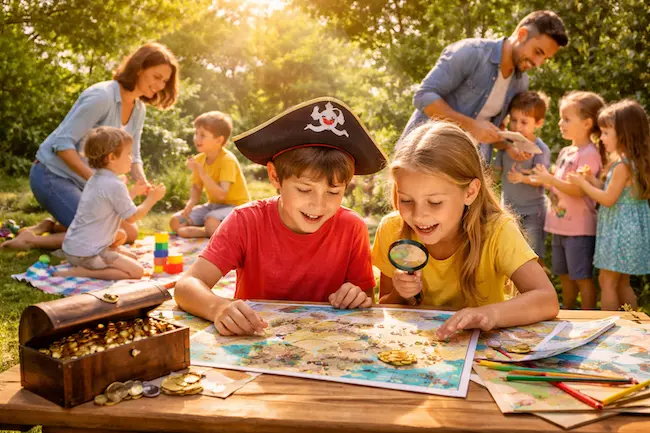
- Pick safe, obvious hiding spots: Keep clues low, accessible, and away from fragile or off-limits areas. Good options are under a cushion, taped under a table, inside a shoe, behind a book, or in a labeled box.
- Use one repeatable game loop: Kids find a clue ? solve it together ? come back to you ? you confirm the answer and give the next direction. This keeps the group on track and stops kids from racing ahead.
- Keep the intro short: One sentence for the mission, two rules (stay together, no running inside), then start immediately with the first clue.
- Timing that works for parties: Plan 20–30 minutes for setup and 45–90 minutes of play depending on age, group size, and space.
Optional shortcut for busy parents: If you don’t want to create every puzzle from scratch, a print-and-play treasure hunt gives you the same fun (hide clues + run the game) with the story and puzzles already ready.
Once the flow is clear, the only thing left is the finale—because a strong ending is what kids remember most.
The final treasure and ending the game
The best finales are quick, clear, and feel like a real “mission complete” moment. You don’t need anything elaborate—just a simple last step and a fun reveal.
- Make the final step easy: One last riddle, a short code, or the final puzzle piece that reveals the hiding place is enough.
- Keep the treasure simple (presentation matters): A small box or themed bag with stickers, candy, mini toys, or badges works perfectly.
- Add a calm closing moment: Congratulate the group, wrap up the story in one sentence, and hand out a small certificate or diploma (great during cake time).
With the ending ready, you can focus on making the whole party run smoothly—especially with a group of excited kids.
Tips to organize a treasure hunt without stress
A treasure hunt runs smoothly when a few key details are anticipated in advance. These practical tips come from real-life party setups and help avoid the most common problems parents face.
- Keep the hunt short and dynamic: More clues doesn’t mean more fun. For most kids, 6–10 steps are enough to stay engaged without losing focus.
- Avoid clues that can be guessed: Each clue should clearly lead to one place only. Ambiguous riddles quickly create frustration.
- Limit waiting time: If kids have to wait too long for their turn, energy drops. Team play or group-solving keeps everyone involved.
- Alternate energy levels: After a clue that requires running or searching, add a calmer puzzle to reset the group.
- Plan a simple backup: Indoor-friendly clues, a mini puzzle, or a quick observation game are lifesavers if the weather changes.
- End with a clear finish: A final reveal, a short celebration moment, or a small ceremony helps children transition calmly to the next part of the party.
- Choose the right moment during the party: Let kids arrive and play freely for 15–30 minutes first, then start the treasure hunt while energy is still high. Cake and gifts work best after the game.
With these adjustments, the treasure hunt becomes easier to manage—and much more enjoyable for both kids and adults.
DIY treasure hunt or print-and-play game?
Making your own treasure hunt is perfect if you enjoy creating puzzles and have time to prepare. A print-and-play treasure hunt is ideal when you want a ready-to-use structure, clear clues, and a complete story with minimal setup—especially for birthday parties.
FAQ: How to make a treasure hunt for kids
Here are answers to the most common questions parents ask when planning a treasure hunt at home or for a birthday party.
Most treasure hunts work best between 45 and 90 minutes, depending on the children’s age, the number of clues, and the size of the play area.
Plan 6 to 10 clues. This keeps the game exciting without making it too long or tiring for kids.
Treasure hunts work well from age 4 and up. Younger kids need visual clues, while older kids enjoy riddles and simple codes.
Yes. Treasure hunts work perfectly indoors using everyday hiding spots like cushions, drawers, bookshelves, or labeled boxes.
Most treasure hunts can be created using items you already have at home: paper, pens, envelopes, and simple props. The key is the structure, not expensive materials.
How to Make a Treasure Hunt for Kids That Really Works
Now you know how to make a treasure hunt for kids without overcomplicating things. With a simple format, age-appropriate clues, and a clear game flow, you can create a fun adventure that keeps children engaged from the first hint to the final treasure. Keep it short, keep it clear, and focus on the experience—kids don’t need perfect puzzles to have an amazing time.
If you’d like more ready-to-use ideas to build an unforgettable birthday with less prep, explore our print-and-play birthday party games for kids and choose the theme your child will be excited to live out.









Thanks to these very good ideas! It looks like si fun! I will try with pleasure with my kids!